
May Day Protests 2026: Workers Rise Against Inequality
Join the global workers in the May Day protests of 2026 as they unite against billionaire power, war, and inequality. Discover the significance of these protests and their impact on the fight for workers' rights.
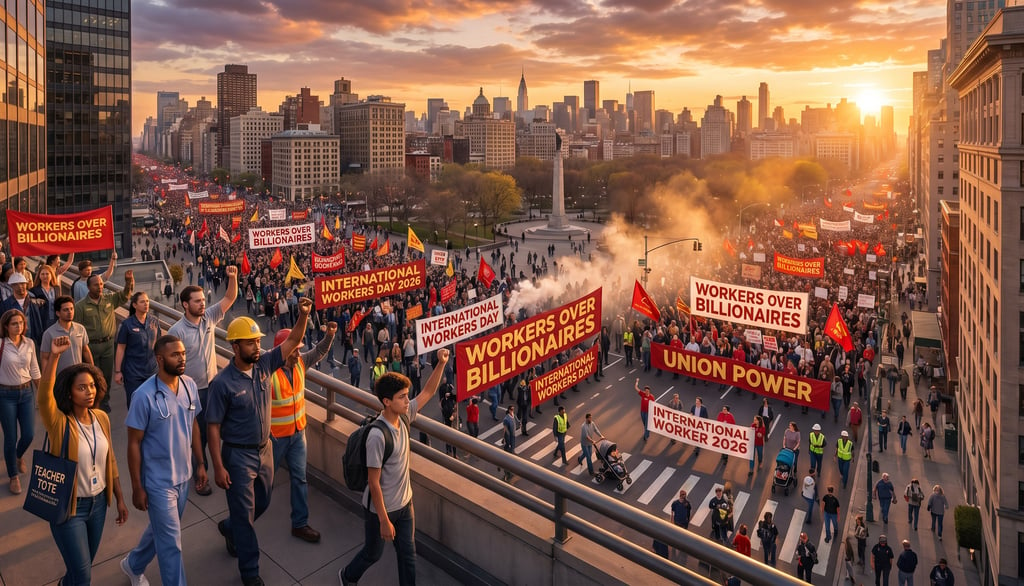

May Day Protests 2026: Global Workers Rise Against Billionaire Power, War, and Inequality
Published: May 2, 2026 | Category: Labor Rights, Global Politics, Social Movements
Introduction: A World on Strike
On May 1, 2026, International Workers' Day transformed into one of the most sweeping days of global protest in recent memory. From the streets of Manila to Daley Plaza in Chicago, from Istanbul's Besiktas district to the National Mall in Washington, D.C., millions of workers, students, educators, and activists joined May Day protests to demand economic justice, immigration rights, peace, and an end to what many demonstrators described as a billionaire takeover of democratic governments.
This year's May Day protests were fueled by a convergence of crises: a global energy shock triggered by the US-Israeli war on Iran, escalating immigration enforcement in the United States, wealth inequality reaching historic levels, and mounting public anger at the Trump administration's domestic policies. Together, these forces turned May Day 2026 into a defining political moment of the year.
What Is May Day? The History Behind International Workers' Day
May Day, formally known as International Workers' Day, is observed annually on May 1. Its roots trace directly to the United States — specifically to Chicago in the 1880s, when labor organizers launched a nationwide strike demanding an eight-hour workday.
The pivotal moment came on May 4, 1886, at Haymarket Square in Chicago, where a bomb detonated during a labor demonstration, leading to violent clashes between police and protesters. The Haymarket Affair, as it came to be known, resulted in deaths on both sides and the arrest and execution of several labor activists. The event reverberated globally, inspiring international labor movements to designate May 1 as a day of worker solidarity.
In 2026, Chicago marked the 140th anniversary of the Haymarket Affair with a plaque dedication ceremony at the Haymarket memorial, attended by Mayor Brandon Johnson, Illinois Secretary of State Alexi Giannoulias, and UAW President Shawn Fain.
Despite being the birthplace of May Day, the United States does not officially recognize it as a federal holiday — a distinction that makes American May Day activism all the more grassroots and defiant.
May Day 2026 in the United States: "Workers Over Billionaires"
The May Day Strong Movement
The centerpiece of U.S. protests in 2026 was the "May Day Strong" initiative — a nationwide day of economic action anchored by more than 500 labor unions, student groups, community organizations, pro-democracy coalitions, immigrant rights groups, and racial justice organizations.
The movement's core call: No Work. No School. No Shopping. — an economic blackout designed to demonstrate the collective power of working people.
Key demands of May Day Strong 2026 included:
Tax the wealthy so families, not billionaire fortunes, come first
Abolish ICE and end immigration enforcement that targets working communities
End the US-Israeli war on Iran and its devastating impact on energy costs
No private armies serving authoritarian power
Expand democracy and protect voting rights
Over 4,000 events were planned across every U.S. state and Washington, D.C., making it one of the largest coordinated labor and civic actions in recent American history.
City-by-City: Where Americans Marched
New York City saw rallies across all five boroughs — from Washington Square Park in Manhattan to Prospect Park in Brooklyn and MacDonald Park in Queens. In Manhattan, an early morning march led demonstrators from Bryant Park toward the residence of Amazon founder Jeff Bezos.
Chicago became a focal point, with thousands gathering at Union Park before marching through downtown to Daley Plaza. Chicago Public Schools teachers and students joined the rally, with the Chicago Teachers Union organizing educational events on voting, civil rights, and advocacy. The city also commemorated the 140th anniversary of the Haymarket Affair.
Washington, D.C. drew thousands to the National Mall, where demonstrators protested Trump administration policies on labor, immigration, and D.C. statehood. Protesters marched near the White House carrying a signed banner representing the U.S. Constitution.
Los Angeles saw crowds gather at MacArthur Park under the banner "Solo El Pueblo Shuts it Down — No Work, No School, No Shopping," marking the 20th anniversary of La Gran Marcha, a 2006 mass protest against anti-immigration legislation. Marchers proceeded to Gloria Molina Grand Park.
Boston's Logan International Airport workers marched together carrying signs reading "Boston workers deserve equity, respect, and opportunity." Mayor Michelle Wu declared, "Boston is a union city!"
Seattle protesters targeted ICE's presence at FIFA World Cup venues, with hospitality workers demanding "No ICE in our Cup."
The "No Kings" Connection: A Broader Anti-Authoritarian Wave
May Day 2026 didn't emerge in a vacuum. It followed a series of mass protest movements that had been building throughout early 2026:
The "No Kings" protest movement had already drawn millions to demonstrations across the country in March 2026, protesting what organizers described as authoritarian overreach by the Trump administration.
A Minnesota statewide economic blackout in January 2026, triggered by the ICE shooting of two U.S. citizens — including Renee Nicole Good — had demonstrated the power of economic disruption as a protest tactic.
The Sunrise Movement, a youth-led climate activist group, reported that over 100,000 students struck from school on May 1, with over a dozen schools cancelling classes due to expected absences by students and teachers.
Global May Day 2026: A World United Against War and Rising Costs
The Iran War's Shadow Over International Protests
The US-Israeli war on Iran cast a long shadow over May Day protests worldwide in 2026. The conflict had triggered a global energy crisis that disproportionately burdened working-class families — pushing fuel, heating, and food costs sharply higher across dozens of countries.
Daniel Bertossa, General Secretary of Public Services International, captured the global mood: rising living costs caused by the war were driving anger among working-class people, creating what he described as "a rare and powerful moment to connect and educate."
Country-by-Country Highlights
Philippines: Among the earliest May Day demonstrations of 2026, protesters clashed with police near the U.S. Embassy in Manila. Marchers carried banners reading "Down With US Imperialism." Josua Mata, leader of the SENTRO labor federation umbrella group, identified the Iran war's impact on energy costs as the central focus of Filipino protests, noting that every Filipino worker now understands their situation as deeply connected to the global crisis.
Turkey: Turkish police arrested hundreds of demonstrators in Istanbul's Besiktas district during May Day rallies, according to a lawyers' association.
France: French unions demonstrated in Paris and other cities under the slogan "Bread, Peace and Freedom" — linking workers' daily economic concerns to the ongoing conflicts in Ukraine and the Middle East.
Italy: Ahead of May Day, the Italian government approved nearly 1 billion euros in job incentives, extending tax breaks to encourage hiring young people and disadvantaged women. Opposition parties dismissed the package as "propaganda."
Japan: Members of Rengo, the Japanese Trade Union Confederation, raised their fists at annual May Day rallies in Tokyo, calling for higher pay and improved working conditions.
South Korea, Australia, Indonesia, and beyond: Demonstrations spread across Asia-Pacific and European capitals, with overlapping demands for peace, higher wages, and political accountability.
Key Issues Driving May Day Protests in 2026
1. Wealth Inequality and the "Billionaire Takeover"
A central theme across U.S. protests was opposition to what organizers called the "billionaire takeover" of government — pointing to wealthy donors' influence over policy. Seattle protester Michael Westgaard, a union member, articulated the mood: "We are the people who create the wealth. Without us, the economy doesn't run."
2. Immigration Enforcement
The Trump administration's immigration crackdown — including aggressive ICE operations — was a galvanizing issue in cities with large immigrant populations like Los Angeles, Chicago, and Seattle. Protesters called for an end to workplace raids that targeted immigrant laborers.
3. Energy Costs and the Iran War
Globally, the surge in energy prices caused by the US-Israeli conflict with Iran united workers across ideological lines. Demonstrators in Asia, Europe, and Latin America linked local economic pain directly to U.S. foreign policy.
4. Labor Rights and Union Power
The eight-hour workday, fair wages, gig economy protections, and anti-union corporate behavior remained foundational labor issues. In the U.S., the National Education Association (NEA) mobilized educators with a dedicated May Day toolkit, framing the protests as a fight for public schools over private profit.
5. Democratic Accountability
From the "No Kings" banner to calls to "expand democracy," many protesters framed May Day 2026 as a defense of democratic institutions against what they characterized as authoritarian consolidation of power.
The Economic Blackout Strategy: Does It Work?
One of the most distinctive features of May Day 2026 in the U.S. was the economic blackout strategy — asking participants not just to march, but to withhold labor, school attendance, and consumer spending for a full day.
Organizers drew inspiration from historical precedents: the 2006 "Day Without Immigrants" — La Gran Marcha — which reshaped May Day's political character in the U.S., and Black-led corporate campaigns that had successfully pressured corporations into policy changes.
The economic blackout model treats workers not merely as political protesters but as economic actors whose collective withdrawal carries measurable financial weight. Analysts noted that a coordinated one-day consumer and labor boycott, even partially observed, signals to corporate and political leaders the latent power of organized workers.
How the Trump Administration Responded
The White House struck a defiant tone in response to May Day protests. Spokesperson Kush Desai stated: "Everyday American workers across the heartland are the foundation of the Make America Great Again movement." The administration claimed it had "never wavered from standing up for American workers," pointing to renegotiated trade deals, manufacturing investments, tax cuts on overtime pay, and border security as evidence.
President Trump also revived a tradition going back to the Eisenhower era by declaring May 1 "Loyalty Day" — a day to celebrate individual liberty.
SEO Keywords & Search Trends: What People Are Searching
The following keywords are trending in connection with May Day 2026 protests:
May Day protests 2026
International Workers Day 2026
May Day Strong
No Kings protest movement
Workers vs billionaires protest
May Day economic blackout
ICE protests 2026
Iran war protests
Labor Day protests US 2026
Haymarket anniversary 2026
May Day global rallies
Anti-Trump protests May 2026
What's Next: The Future of Labor Activism
May Day 2026 is widely seen as a milestone in a longer arc of civic mobilization. Key questions moving forward include:
Will the economic blackout model expand? Organizers plan to use May Day as a template for future boycott actions tied to policy milestones.
Can the coalition hold? The "May Day Strong" coalition spans climate activists, labor unions, immigrant rights groups, and pro-democracy organizations — a broad tent that carries both strategic power and internal tensions.
How will global energy costs evolve? The Iran war's ongoing impact on fuel prices will continue shaping labor politics internationally.
Will 2026 midterms be a turning point? Many organizers explicitly framed May Day action as groundwork for electoral mobilization, arguing that marching must translate into voting and community organizing.
Conclusion: May Day as a Mirror of the Moment
May Day protests in 2026 served as a vivid mirror of the world's most pressing tensions: between workers and concentrated wealth, between militarism and economic stability, between democratic accountability and authoritarian consolidation.
From Chicago's Union Park — where the eight-hour workday movement was born 140 years ago — to the streets of Manila, Istanbul, Paris, and Los Angeles, the message of May Day 2026 was consistent: working people are not passive spectators in the political and economic forces that shape their lives. As Daniel Bertossa put it, "May Day is a vivid reminder that working-class politics is not a spectator sport."
Whether the energy of May 1, 2026 translates into lasting policy change remains to be seen. But the scale, diversity, and global reach of this year's demonstrations make clear that the labor movement — long declared weakened — has found new vitality at the intersection of economics, immigration, foreign policy, and democracy.
Keywords: May Day protests 2026, International Workers Day, May Day Strong, labor rights, workers over billionaires, anti-Trump protests, economic blackout, immigration rights, Iran war energy crisis, Haymarket anniversary, global workers rally, No Kings movement